

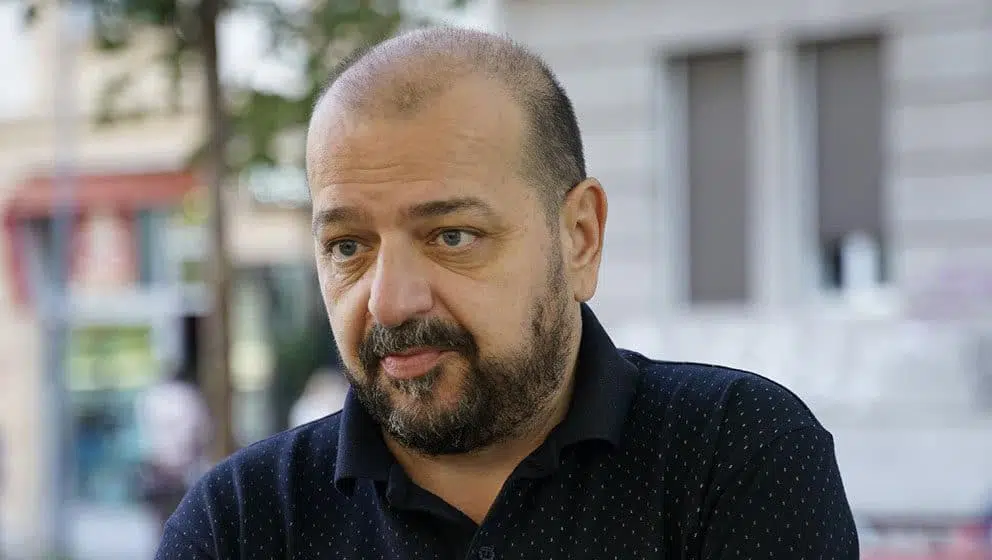
Former Serbian Progressive Party (SNS) MP Dragan Šormaz, in an interview with Radar Report, discusses Aleksandar Vučić’s loss of power after 14 years, the Student List’s victory with 143 seats, the impact of the Kosovo issue on the election result, and Milan Radoičić’s future following the attack in Banjska.
- Radar Report: How did Aleksandar Vučić’s 14-year rule come to an end following his defeat by the Student List?
Aleksandar Vučić’s defeat was the result of years of growing political discontent, which the student movement managed to transform into a powerful social and political force.
Vučić’s system of government was built on a personality cult, absolute media control, the capture of state institutions by the ruling party, clientelism, and the creation of an order in which loyalty mattered more than individual qualifications. For years, this model successfully secured electoral dominance, but at the same time it generated growing public dissatisfaction.

The turning point was the de facto (although not formally declared) abandonment of Serbia’s EU membership aspirations. European rules and standards were gradually discarded, while the state became increasingly entangled in networks of crime and corruption. This ultimately led to the tragedy in Novi Sad, in which 16 people lost their lives. It exposed the devastating reality that corruption literally kills and exacts a deadly human toll.
The students succeeded in articulating the growing public discontent, but they also managed to outmanoeuvre the regime through an innovative model of political mobilisation, overcoming the traps set by the authorities and ultimately defeating Vučić’s political machinery.
Confronted with an unfamiliar opponent, Vučić repeatedly made one political mistake after another, eventually retreating into the familiar radical-nationalist narrative that the majority of Serbian citizens had always viewed with contempt.
The most important message of these elections is that no political dominance lasts forever, and that control over institutions, the media and state resources cannot indefinitely substitute for citizens’ trust.
- Radar Report: What specifically contributed to the Student List winning 143 seats?
The Student List’s greatest advantage was that it did not present itself as a conventional political party, but rather as the expression of a broad social movement. It managed to unite people with different political, ideological and philosophical orientations around several common objectives aimed at resetting the system. These included fighting corruption, establishing the rule of law, ensuring institutional accountability and securing free elections.
Another advantage was that it was not burdened by the political legacy of the traditional opposition. A large number of voters who had previously been unwilling to support existing opposition parties were now given an opportunity to vote for political change without feeling that they were returning to the same old political actors.
Another important factor was mobilisation. The students managed to build a nationwide support network, reach smaller communities and engage a large number of citizens, particularly young people, who had previously been politically passive. Their campaign did not depend exclusively on television appearances and traditional media. Instead, it relied on direct contact with citizens, social media and the trust the movement had built during the protests.
It is also important to recognise that a significant proportion of voters did not necessarily vote for a clearly defined political programme put forward by the Student List, but rather against Vučić’s regime. This is precisely the greatest challenge facing the Student List: it must now demonstrate that it can evolve from protest-driven political energy into sustainable and responsible state governance.
- Although Vučić’s campaign relied heavily on propaganda, particularly by bringing Kosovo into the discussion, was he also punished by voters on this issue?
I believe Kosovo was one of the factors contributing to Vučić’s political defeat, although I would not say it was the decisive issue determining the election result.
For years, Vučić attempted to use the Kosovo issue as an instrument of domestic political mobilisation. Whenever he faced criticism over corruption, organised crime, economic problems or the state of democracy, he would frequently try to shift the political debate towards national and security-related issues.
However, Serbian citizens are tired of grand nationalist narratives and increasingly understand that patriotism cannot replace government accountability, nor can national interests be protected through propaganda, the deliberate incitement of hatred and the perpetuation of endless conflicts that have become an end in themselves.
There is another important problem. For years, Vučić built his political legitimacy on the promise that he would protect Serbian interests in Kosovo. At the same time, however, his policies contributed to the increasingly difficult position of Serbs in Kosovo, who have been left at the mercy of local criminal groups and the Serbian List, which functions as their political arm.
The Banjska incident particularly exposed the dangers of such a policy. Instead of Serbia consistently protecting the interests of the Serbian community in Kosovo through its institutions and diplomatic channels, we witnessed a security crisis with serious international consequences.
I believe some voters punished Vučić precisely because of the gap between his nationalist political rhetoric and the actual results of his Kosovo policy, which, despite all the rhetoric, has seriously undermined Serbia’s interests and position.
- Radar Report: What approach towards Kosovo can we expect from the Student List following Vučić’s political defeat?
I expect the new government to make a fundamental shift in the way Serbia conducts its Kosovo policy. However, this does not mean that it should abandon the protection of the legitimate interests of the Serbian community in Kosovo.
The most important change should be the abandonment of a policy based on improvisation, secret deals and personalised diplomacy. Kosovo is far too important a national and state issue to be reduced to one individual’s day-to-day political calculations.
The new government will have to rebuild trust with international partners, particularly the European Union and the United States, while insisting on the full implementation of existing commitments and agreements on normalisation. This also includes resolving the issue of the status and rights of Serbs in Kosovo in accordance with European standards and the need to ensure the smooth functioning of Kosovo’s institutions.
At the same time, political communication with representatives of the Serbian community in Kosovo must be restored. The practice of treating them as instruments for advancing Belgrade’s political interests must come to an end. Their security, institutional rights, education, healthcare, property rights and freedom of movement must become genuine priorities.
One fact must also be understood: Serbia cannot pursue a long-term solution to the Kosovo issue while remaining in conflict with its own European aspirations. We need a policy that brings together the protection of Serbian interests, regional stability and European integration.
This does not mean abandoning national interests. It means moving away from a politics of confrontation towards a policy of resolving conflicts through dialogue.
- Radar Report: We have information suggesting that Milan Radoičić, who organised and carried out the attack in Banjska, has fled to Russia. How likely is this information to be true?
For the time being, I would be very cautious about such a claim. I do not have reliable and independently verified information proving that Milan Radoičić is currently in Russia. Therefore, I would not speculate about his present whereabouts.
However, a much more important question is why a man who publicly admitted to organising an armed group involved in the attack in Banjska has still not faced full judicial accountability in Serbia itself.
I would remind you that the attack in Banjska on 24 September 2023, in which Kosovo police officer Afrim Bunjaku was killed, was one of the most serious security incidents in the region in recent years. This was not an ordinary criminal incident, but an event with serious political, security and international consequences.
For Serbia, it is particularly damaging that the Radoičić case has become a symbol of the links between organised crime, informal power structures and the political system. His possible whereabouts are certainly important, but an even more important question is who enabled him to build such a position of influence and what political and institutional structures stood behind his activities.
- Radar Report: If Radoičić is not in Russia, what will happen? Will the new government in Serbia hand Milan Radoičić and his group over to justice for the attack in Banjska?
I believe this must be one of the important issues facing the new government, not only because of Serbia’s relations with Kosovo and the international community, but primarily because of Serbia’s own interests and the rule of law.
An independent, professional and comprehensive investigation must be conducted, one that goes beyond the immediate perpetrators of the attack. It is essential to establish who organised, financed and provided logistical support for the operation, what the chain of command was, and whether individuals within state institutions had any role in, or prior knowledge of, the preparations.
Milan Radoičić and all other suspects must be brought before the judicial authorities and held accountable in accordance with the evidence and the law. No one should be protected because of political connections, financial power or previous ties to representatives of the government.
Nevertheless, an important legal distinction must be made. Serbia cannot simply treat the handover of all suspects to Kosovo’s institutions as an automatic legal procedure. The jurisdiction of courts, international legal obligations and procedures for judicial cooperation must be respected. What is beyond dispute, however, is that Serbia must not become a safe haven for individuals suspected of serious criminal offences.
For me, the real test of the new government will be whether it is prepared to break with the practice of politically protecting individuals who were part of informal power structures. If it wants to restore the rule of law and rebuild the trust of the international community, it will have to demonstrate that the law applies equally to everyone, regardless of how close they were to the previous regime.
The Banjska case must not become an instrument of political bargaining or a means of temporarily improving Serbia’s international image. It must be addressed through genuine judicial accountability.




Recent Comments